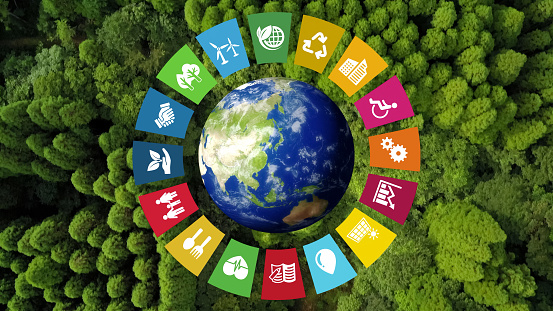
Over the years, several development plans have been put in place to help improve the quality of life in developing counties. As far back as the year 2000, the Millennium Development Goals (MDGs), a set of 8 development goals were identified by the United Nations and international development community, as important focus areas for improving the quality of life in developing countries like Nigeria. While slow progress was made in some areas, critical challenges still persisted in other areas. Although the MDGs expired at the end of 2015, a lot still needed to be done. At the expiration of the MDGs, over 112 million Nigerians still lived in extreme poverty and hunger, insecurity level was still high, CO2 emissions had increased, maternal health mortality was still high, and so on.
Therefore, at the 70th Session of the United Nations (UN) General Assembly, held in September 2015, world leaders adopted the 2030 Agenda for Sustainable Development. The 2030 Agenda for Sustainable Development agenda articulates the UN’s universal call to end poverty, protect the planet and ensure that all people enjoy peace and prosperity, expressed with 17 goals, 169 targets and 230 key performance indicators.
Nigeria commenced the implementation of the Sustainable Development Goals (SDGs) in January 2016, following the adoption of the 2030 Agenda. Institutional frameworks were established at the national and sub-national levels to support effective implementation. With this, several strategic initiatives were implemented between 2016 and now.
IMPLEMENTATION OF THE SDGs
Several initiatives have been implemented to achieve the SDGs. For instance, the National Social Investment Programme, implemented in December 2016, has been a cornerstone programme for targeting the poor and vulnerable members of the Nigerian population and empowering the unemployed youth in three categories: Young graduates, Semi-skilled, and Unskilled labour. The programme comprises of National Homegrown School Feeding Programme (NHGSFP) for public primary schools; N-Power for unemployed graduates, Government Enterprise and Empowerment Programme (GEEP) to encourage market women, artisans and traders; the Conditional Cash Transfer to the less privileged. Despite these efforts, unemployment and poverty still remain on the high. Unemployment and underemployment have risen from 13.9% and 19.7% respectively in Q3 2016 to 33.3% and 22.8% respectively in Q3 2021.
With the daunting figures of over 40% or 83 million Nigerians living in extreme poverty, a spiking unemployment rate, over 13 million school-age children out of school, etc., it is evident that the measures put in place for the implementation of the SDGs haven’t been as effective as expected. The identified gaps above beg for a reflection of Nigeria’s commitment to meet the SDGs by 2030. To achieve the SDGs within the next nine years, there is need for specific interventions driven by a sustained political will. Strategic and effective poverty alleviation programmes should be put in place, to enable Nigerians benefit from quality inclusive education, escape multidimensional poverty, access balanced diets and the right to universal health coverage. In addition, priority should be placed on human capital development and human welfare as they are the bedrock of sustainable development in any nation.
FUNDING OF THE SDGs
Given the 17 SDGs, the important role of finance in funding these goals cannot be overemphasized. Some funding efforts have been put in place by the government, including a recent move to establish a special SDG intervention fund, which will run for 15 years.
Globally, the cost of eradicating poverty is estimated at $66 billion annually while investment required to improve infrastructure is estimated to be $7 trillion. Financing these expenditures requires huge funds which the government alone cannot provide. Hence, the private sector also has a huge role to play in supporting the government to raise the needed funds and improve access to finance which are crucial in achieving the SDGs.
With a population of over 200 million, research shows that over 36% of Nigerian adults are financially excluded. It is estimated that achieving the SDGs requires overcoming a critical financing gap of $5-7 trillion per year globally and an estimated $83 trillion (N125 trillion) nationally in Nigeria. This requires a greater role of the private sector and significant transformation in how economic growth and investment opportunities are generated.
Owing to the immense financial resources, expertise, and involvement required to sufficiently achieve these goals, the private sector, as well as the government, has an important role to play in financing these goals.
 Geek
Geek 