
In the pursuit of development, many developing countries have a lot of factors to consider and policies to be implemented in line with these factors; a comprehensive consideration and implementation of which, would lead to sustainable growth and development. Over time, trade has been identified as having the power to help developing countries achieve robust economic growth and sustainable development and therefore, lift developing countries out of poverty.
African countries, in recognition of this, have thus developed different programs to assist their countries with this, particularly “behind the border issues” – measures to increase investment, measures to improve production and productivity of output and inputs respectively, so that in addition to trading goods and services within the countries, they could also trade internationally and earn the much needed foreign exchange many of them seek to make their economies work better. For example, in Cote d’Ivoire, measures were put in place to improve the output and productivity and management of the coffee sector, in order to boost export capacity and thus, foreign exchange earnings.
In Nigeria, import restrictions on certain locally produced alternatives have been previously implemented such as the ban of the importation of 41 items by the government in 2015. In some ways, this helped to promote the development and growth of local industry and production. With similar measures, the value of Nigeria’s total trade in Q2 2021 amounted to N12.03 Trillion representing a 23.28% increase compared to Q1 2021 value and 88.71% increase compared to Q2 2020. Imports were valued at N6.95 Trillion or 57.78%, indicating a 1.45% increase in Q2 2021 against the level of imports in Q1 2021 and 67.49% increase compared to Q2 2020. On the other hand, exports were valued at N5.08 Trillion, indicating an increase of 74.72% compared to Q1 2021 and 128.29% compared to Q2 2020.
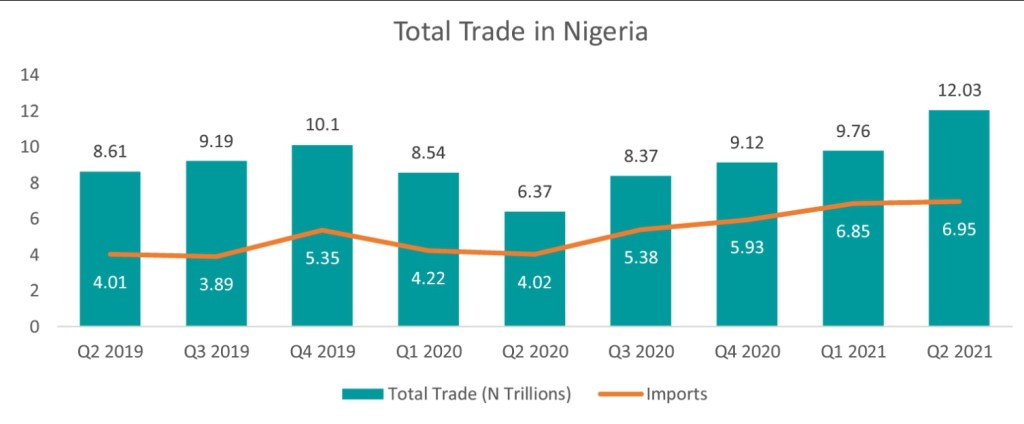
Per the National Bureau of Statistics Foreign Trade Report, Q2 2021 had the fourth rise in total trade since Q2 2020. This was driven mainly by the rise in the export value of crude oil in Q2 2021. However, despite the rise in the value of exports compared to previous quarters, a deficit was still recorded resulting in a Balance of trade deficit of N1.87 Trillion. This could be attributed to the lack of diversification in the export components during this quarter. Crude oil, being the main component of export trade, contributed 80.29% or N4.08 Trillion to total exports, indicating an increase of 111.32% in Q2 2021 compared to Q1 2021. On the other hand, non-crude-oil export stood at N1.00 Trillion or 19.71% of total exports in Q2 2021.

Among some of the efforts made to improve trade in Africa, include the signing of various trade agreements with different potential benefits. Nigeria, for example, has been a party to several trade agreements including the African Continental Free Trade Area (AfCFTA). Signed by 54 countries and implemented on January 2021, the African Continental Free Trade Area (AfCFTA) is poised to revamp international trade in Africa. The agreement comprises of benefits such as reduction of tariff and non-tariff barriers, the elimination of red-tape, and the simplification of custom procedures in order to create a single market for goods and services. This provides an avenue for Nigeria and other African countries to reach their growth potentials. Per the African Development Bank, Nigeria’s economy is expected to grow by 2.9% in 2021. A significant percentage of that growth is expected to be driven through trade. These trade agreements therefore create opportunities for local Nigerian businesses in terms of easing up the process involved in regional exports, through efficient new supply chains. With these established new regional networks, investors are exposed to lucrative investment opportunities. New business opportunities have been created for different sectors with the need for logistics infrastructure as well as capital injection in the logistics supply chain.

Trade agreements such as AfCFTA, set up Nigeria, and other African countries, to favourably gain from the trade and investment opportunities they provide. However, in addition to trade agreements like AfCFTA, other factors come must be considered. Logistical issues, for example, take a huge toll on the eventual results. Lorries and containers spend days waiting at borders to cross over. Furthermore, more value must be added to our exports in order for them to witness a significant increase in demand and thus, a rise in foreign exchange earnings and consequent a reduction in the devaluation of our currency. Rather than exporting the same raw materials we have done over time, we can process those products, create jobs in the process, and earn relatively higher foreign exchange earnings. For instance, exporting coffee, chocolates, etc. rather than raw cocoa, for countries like Ghana and Cote d’Ivoire where cocoa constitutes a huge part of exports.
In conclusion, the importance of trade in the development process of any economy cannot be overemphasized. For trade to be productive, value must be created – money must be exchanged for value. Therefore, efforts should be made to increase in the value added to other sectors such as agriculture, mining, manufacturing, services, technology, etc. Consequently, a progressive diversification from the overdependence of crude oil exports would organically occur and a more robust, sustainably developed economy would gradually emanate.
 Geek
Geek 